

 ACCESS
 JAPANESE
 SEARCH
LABORATORIES
Basic Pharmaceutical Education and Research
Faculty
Introduction(Molecular Biology and Physiology)
Hyperresponsiveness in Allergy
Hyperresponsiveness in Allergy
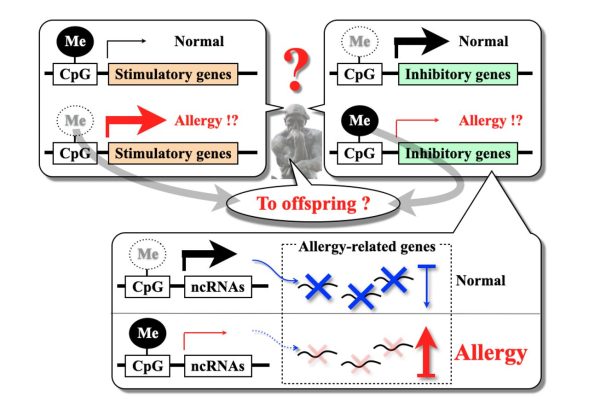
The tissue/organ hyperresponsiveness is a characteristic feature of allergic diseases. For example, people with allergic asthma have non-specific bronchial hyperresponsiveness, causing severe bronchoconstriction even in daily environments with infinitesimal dust, cold air, and so on. People with allergic rhinitis and atopic dermatitis also have nasal and skin hyperresponsiveness, respectively. To date, mechanisms of hyperresponsiveness in allergic diseases are largely unknown. We thus try to understand the underlying mechanism of hyperresponsiveness using animal/cell models of allergic diseases.
Current Research Interests:
- Epigenetic/epitranscriptomic changes in non-immune cells in allergy
- Epigenetic transgenerational inheritance of allergic susceptibility
Introduction(Mechanistic Control of Behavioral Plasticity)
How can we stop it? The science underlying this loss of control......
How can we stop it? The science underlying this loss of control......
Inside neurons, many proteins interact to transmit information as stimuli and maintain homeostasis. On the other hand, during pathogenesis, plastic changes can occur in response to stimuli, and when they lose control, apoptosis can be triggered. We will study the behavioral and cellular aspects of these pathologies or diseases that were thought to be uncontrollable.
Drug Dependence
The mechanisms for the establishment of the condition known as drug addiction, which deprives the mind and body of freedom accompanied by opposite conditions such as pleasure and the suffering of withdrawal, are being studied from both intracellular and behavioral perspectives.
Neurodegenerative Diseases
Based on the hypothesis that the disruption of anti-apoptotic proteins can trigger several degenerative diseases, the mechanism of such neurodegenerative diseases will be biochemically elucidated.
Treatment Resistant Psychiatric Disorders
To find the seeds of drug discovery, we focus on psychiatric disorders, particularly those that are resistant to treatment.
Introduction(Sport Science)
In recent years, the pieces of evidence that exercise has important roles in keeping healthy have been reported by various analytical methods in physiology, biochemistry, and histology. Our Laboratory aims to propose a new integrated medicine by establishing efficient exercise therapy with exercise and “something extra”. We are conducting research on the following three themes using sources such as “bioactive peptides”, “aromatherapy”, and “supplements” as “something extra”.
- Functional morphological analysis of the physiological effects of exercise and nasal administration of bioactive peptides: We aim to develop a new exercise therapy for the elimination of obesity. We combined exercise with intranasal administration of Galanin-Like Peptide (GALP), one of the eating-related peptides, and we investigated its effect using mice. In addition, with an aim of preventing and improving dementia, the combination of pituitary adenylates cyclase-activating polypeptide (PACAP), which is involved in nerve regeneration, and exercise, will promote neuronal regeneration in the hippocampus. We are verifying its action from histological and behavioral analysis.
- Evidence building at the molecular level for the establishment of medical aromatherapy: Essential oils used in aromatherapy have been found to have various pharmacological effects, including anti-stress, antibacterial, antidepressant, and pain relief. In recent years, it has been introduced as “medical aromatherapy” in the medical field. However, there is little scientific verification of its effectiveness. Therefore, in our Laboratory, we are verifying various effects of essential oils in cultured cells, animals, and humans, aiming to build evidence for the establishment of medical aromatherapy.
- Molecular basis for the health-promoting effects of combined exercise and aromatherapy: In recent years, aromatherapy using essential oils has been performed at sports sites, and using “sports aromas”, athletes are expected to recover from mental and physical fatigue and improve performance in sports, which is attracting attention. Therefore, we are verifying the effects of aromatic baths after exercise exhaustion from the secretion of various hormones in humans and animals. In addition, we use a mouse myoblast cell line called the “in vitro exercise model” to analyze the effects of essential oil treatment by changes in myokine secretion and gene expression through DNA array analysis.
 TOP
TOP